Back to BlogCV Tips 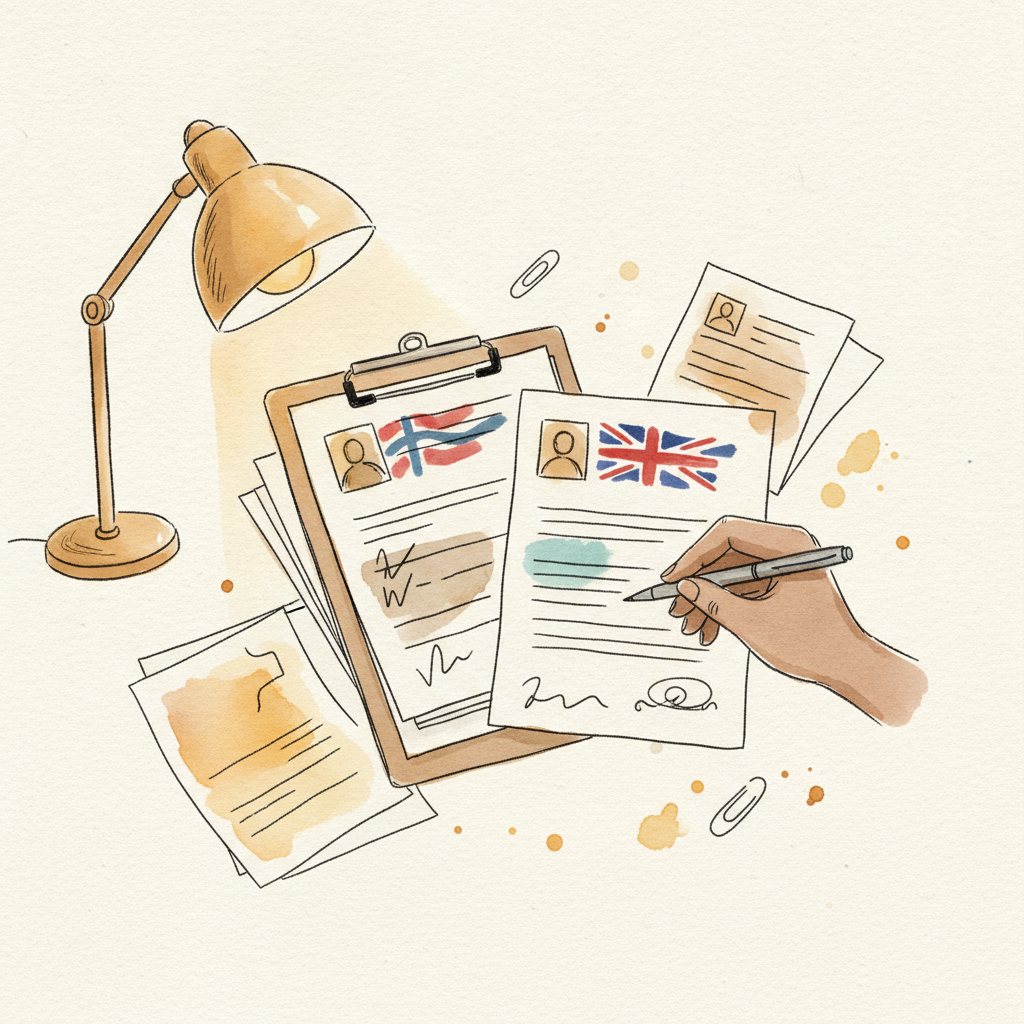 Create your CV
Choosing Between English or Norwegian CVs for Norway Jobs
Learn how to decide whether to submit your CV in English or Norwegian based on sector and employer type, and keep both versions aligned.
Create your CVUnderstanding sector language expectations
Norwegian employers still think of the CV + jobbsøknad pair as the standard application package. The language you choose for the CV should match the sector’s everyday working language.
-
Energy and offshore – Companies in Stavanger and the surrounding oil & gas region operate globally. Their engineering, project‑management and sustainability teams often publish job ads in English, and an English CV (or cv på engelsk) is expected. The same holds for renewable‑energy firms that collaborate with international partners.
-
Technology and digital services – Oslo’s tech cluster is heavily export‑oriented. Start‑ups, SaaS providers, and large IT consultancies list requirements in English and look for candidates who can communicate with offshore development teams. Here a cv på engelsk signals that you can work in an English‑speaking environment.
-
Maritime and shipping – The maritime industry serves worldwide customers. Many ship‑owners and logistics firms post bilingual ads, but the default language for technical roles is English.
-
Public sector and local SMEs – Municipalities, health‑care providers, and many small‑to‑medium enterprises prefer a Norwegian CV (cv på norsk) and a jobbsøknad written in Norwegian. The tone is modest, factual, and aligned with the local jante‑law sensibility.
-
Regional nuance – Even within the same industry, language expectations can shift. A municipal planning department in Oslo will almost always require a Norwegian application, while an international oil service company in Stavanger may accept either language but leans toward English.
Understanding these patterns prevents you from sending a cv på engelsk to a role that expects a cv på norsk, which can be perceived as a lack of local awareness.
Evaluating the employer and job posting
The first place to look for language cues is the job advertisement itself.
-
Explicit wording – If the posting says “Send CV på norsk” or “English CV preferred,” follow that instruction verbatim. Recruiters often filter applications automatically based on these keywords.
-
Company communication style – Visit the employer’s website, careers page, and LinkedIn profile. If employee bios, press releases, and corporate news are primarily in English, the organization likely values English‑language applications. Conversely, a municipal website that publishes all content in Norwegian signals a Norwegian‑only preference.
-
Bilingual postings – Some listings provide both language options. In that case, default to Norwegian for public‑sector or locally focused roles, and to English for positions that mention “global client base,” “international projects,” or “English‑speaking team.”
-
Job title and keywords – A title such as “Project Engineer – Offshore (English required)” is a clear indicator. When the posting lists technical tools with their English brand names (e.g., “ANSYS,” “Python”), it is another hint that an English CV will be read more comfortably.
-
Cross‑checking – If you are unsure, a quick scan of recent employee posts on LinkedIn can reveal the language they use to describe their work. A pattern of English posts suggests the recruiter will expect an English CV.
By systematically checking these signals, you avoid the common mistake of mismatching language and increase the chance that your jobbsøknad and CV are read in the intended context.
Maintaining two consistent CV versions
Many professionals who work across sectors keep both a Norwegian and an English version of their CV. Consistency is key; the two documents should be mirror images in structure, content, and chronology.
Build a master data sheet
Create a spreadsheet with columns for:
- Date range (month / year)
- Employer name
- Role title
- Core responsibilities (bullet‑point format)
- Measurable results (e.g., “Reduced downtime by 12 %”)
- Certifications and tools
Enter each achievement once, using concise English phrasing. This becomes your source of truth.
Translate with a style guide
When you copy the data into the Norwegian version, use a consistent translation table for common terms:
| English term | Norwegian equivalent |
|---|---|
| Project Engineer | Prosjektingeniør |
| Lead | Ledelse |
| Stakeholder | Interessent |
| KPI | Nøkkelindikator |
Keep the same heading hierarchy (e.g., “Professional Experience,” “Utdanning”) and bullet‑point style. Avoid mixing languages within a single document; a cv på engelsk must be entirely in English, and a cv på norsk entirely in Norwegian.
Leverage the CV builder
The CV Pro Maker interface is in English, but you can input Norwegian text without issue. Use the “Export” function to generate PDFs for both language versions in one session. After export, run a spell‑check in each language and verify that industry‑specific terminology (e.g., “hydro‑kraft” vs. “hydropower”) matches the target audience.
Proofreading checklist
- Verify dates and numbers are identical in both versions.
- Confirm that the tone remains modest and factual; replace any overly boastful phrasing with concrete results.
- Ensure the GDPR‑compliant personal details section mirrors the same fields (no national ID, no marital status).
For a deeper dive into GDPR‑lean personal sections and the jobbsøknad pairing, see our guide on Master the Norwegian CV: 1‑2 Pages, GDPR Details & Jobbsøknad Pairing.
Common mistakes to avoid
Even with a solid process, small errors can undermine your application. Below are pitfalls that specifically affect the cv på engelsk eller norsk decision.
-
Submitting the wrong language – Sending an English CV to a municipality that asked for a Norwegian one signals that you have not read the ad carefully. Recruiters may dismiss the application before reviewing content.
-
Mixing languages – A bilingual CV that contains sections in both English and Norwegian looks unprofessional and can confuse ATS parsers. Keep each version pure.
-
Loose translation of the jobbsøknad – The cover letter should not be a literal word‑for‑word translation. Instead, mirror the tone, keywords, and required competencies of the original posting in the chosen language. A well‑crafted Norwegian jobbsøknad can be as persuasive as an English one when it follows local conventions. For tips on writing a strong Norwegian application letter, read How a Strong Norwegian Job Application Letter Complements Your CV.
-
Neglecting sector‑specific terminology – Using the wrong term for a certification or tool can make you appear unfamiliar with the local industry. Double‑check that “Class 1 offshore certificate” appears as “Klasse 1 offshore‑sertifikat” in the Norwegian version.
-
Over‑loading with graphics – While modern templates look attractive, Norwegian recruiters in the public sector still prefer a clean, text‑focused layout. A photo is optional and increasingly omitted; if you include one, make sure it is professional and not a casual selfie.
-
Forgetting to update both versions – After a promotion or new project, update the master sheet first, then regenerate both PDFs. Leaving one version outdated can cause inconsistencies that raise questions during the interview stage.
By systematically checking each of these items, you ensure that whether you submit a cv på engelsk or a cv på norsk, the document is polished, sector‑appropriate, and ready for the Norwegian hiring process.
Additional resources
- Browse the full library of CV templates to find a layout that works for both languages: /cv-templates
- Explore sample resumes for specific professions to see how sector language is handled: /resume-examples
Ready to put this into practice? Build your CV with CV Pro Maker using ATS-friendly templates that put these principles to work. Building, editing and previewing are free — no credit card to start. To download a polished PDF or DOCX, grab a one-time pack: pay once, no subscription.
New to the site? See what's free and what you pay for.
Related Articles
Understanding Autorisation for Health Professionals in Norway’s Market
Find out which health professions in Norway need autorisation, how language requirements interact, and how to pursue jobs while your authorization is
Aviation CV Guide for Moroccan Engineers – Key Employer Requirements
Discover how Morocco’s aviation sector, centered in Casablanca, evaluates CVs. Learn which technical skills, quality certifications and project details to
How to Build a CV Without Experience for Norwegian Students
Learn step‑by‑step how Norwegian students and first‑job seekers can turn studies, volunteer work and part‑time jobs into a compelling CV, and avoid common
How a Strong Norwegian Job Application Letter Complements Your CV
Learn what a Norwegian jobbsøknad should contain, how it adds value to your CV, and avoid common pitfalls that cost you interviews.
Ready to create your CV?
Use our professional templates to build an ATS-friendly CV in minutes.
Browse Templates